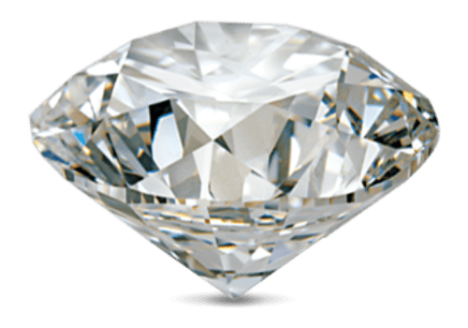
Diamond is the only gemstone made of a single element — carbon, at roughly 99.95% purity. Graphite is also pure carbon, but it’s soft enough to leave marks on paper. The difference is atomic arrangement: diamond’s carbon atoms are locked into an incredibly rigid crystal structure, making it the hardest natural material on Earth.
That’s the science. Here’s what it means for you as a buyer.
The Four Cs: Where Diamond Value Lives
The concept of grading diamonds by color, clarity, and carat weight dates back over 2,000 years to India. Cut was added later — once people figured out how to actually shape these things. Together, these four factors create a diamond’s unique fingerprint of value. No two combinations are identical.
Color: The D-to-Z Scale
Most diamonds used in jewelry are technically near-colorless with slight yellow or brown tints. The GIA color grading scale runs from D (colorless) through Z (light yellow or brown), developed by Richard Liddicoat at GIA in the 1950s. The scale starts at D specifically to avoid confusion with earlier, inconsistent grading systems.
Here’s the practical breakdown: D–F diamonds are colorless, G–J are near colorless, K–M are faint, N–R are very light, and S–Z are light. Set in yellow gold, a J, K, or L diamond under half a carat can look nearly colorless to the untrained eye. But once you get beyond M, most consumers can spot the tint, and as grades approach Z, color becomes obvious even in small stones.
Fancy color diamonds are a different category entirely. These are stones with more color than Z on the yellow/brown scale, or diamonds that show any other face-up color — blue, pink, green, orange. They’re graded on the presence of color rather than the absence of it, with grades ranging from Faint through Fancy Vivid and Fancy Deep. Fine red diamonds are the most rare and valuable of all gems. The Hope Diamond, one of the most famous gems in history, is a 45-carat cushion-cut fancy deep grayish blue.
About 35% of diamonds fluoresce — they glow under UV radiation. This doesn’t typically affect value significantly, but it’s something to be aware of.
Clarity: What’s Inside Matters
Clarity measures a diamond’s degree of freedom from inclusions (internal characteristics) and blemishes (surface characteristics). GIA established the industry-standard clarity scale:
Flawless and Internally Flawless (IF) sit at the top — no inclusions visible under 10x magnification (IF allows minor surface blemishes). These are exceptionally rare.
VVS1 and VVS2 (Very Very Slightly Included) contain minute inclusions that are extremely difficult to very difficult to see at 10x. VS1 and VS2 (Very Slightly Included) have inclusions that range from difficult to somewhat easy to see. SI1 and SI2 (Slightly Included) have inclusions that are easy or very easy to see under magnification. I1, I2, and I3 (Included) have inclusions obvious under 10x — with I3 stones often lacking transparency and durability.
Here’s the number that puts clarity in perspective: fewer than 1% of diamonds mined are free of inclusions. The vast majority of diamonds in jewelry carry some. The question is whether those inclusions affect the stone’s beauty to the naked eye and its structural integrity over time.
Clarity grading considers five factors: size, number, position (center of the table is worst), relief (contrast against the diamond), and nature (what type of characteristic it is and how it might affect the stone).
Common inclusions include feathers (breaks), clouds (clusters of tiny pinpoints), crystals (mineral crystals trapped inside), and needles (thin, elongated crystals). Some blemishes — like naturals (portions of the original rough surface left after cutting) — are actually proof the cutter maximized the stone’s weight.
Cut: Where Craftsmanship Meets Physics
Cut is arguably the most complex of the Four Cs because it directly controls how a diamond interacts with light. Three optical properties define a well-cut diamond:
Brightness (or brilliance) — the combination of all white light reflections. Fire — flashes of spectral color caused by the separation (dispersion) of white light. Scintillation — the sparkle pattern of light and dark areas as the diamond or observer moves.
A diamond has three major sections: the crown (top), the girdle (the narrow band around the middle), and the pavilion (bottom). The crown and pavilion have flat polished surfaces called facets. A standard round brilliant has 57 or 58 facets (58 if there’s a culet — the tiny facet at the very bottom point).
The proportions of these sections — table size, crown angle, girdle thickness, and pavilion depth — determine how light enters, bounces around inside, and exits the stone. Get it right and you get maximum brightness and fire. Get it wrong, and light leaks out the sides or bottom. A pavilion that’s too shallow creates a dark ring under the table (called a “fisheye”), while one that’s too deep creates a dark center.
Marcel Tolkowsky, the father of modern cut research, created the first mathematical model for ideal diamond proportions in the early 20th century. His work remains foundational to how diamonds are cut and graded today.
Beyond round brilliants, other shapes are called fancy cuts — marquise, princess, pear, oval, heart, and emerald. Brilliant cuts produce more fire, while step cuts (like the emerald cut) show color better. The emerald cut is the most popular step cut, typically featuring 57 or 58 facets with a rectangular table and beveled corners.
Carat Weight: Size, Rarity, and the Price Curve
One metric carat equals 200 milligrams — one-fifth of a gram. To put it in perspective, 142 carats equals about one ounce. One carat is divided into 100 points, so a 0.50-carat stone is often called a “50-pointer.” A 1.00-carat round brilliant typically has a girdle diameter of approximately 6.50 mm.
Most diamonds are under one carat. Larger stones are disproportionately rare, which is why per-carat price doesn’t scale linearly — it jumps at key weight thresholds. A 1.01-carat diamond costs measurably more per carat than a 0.99-carat stone of identical quality.
When a piece contains both diamonds and colored stones, the combined weight is called total gem weight. When all stones are diamonds, it’s total weight.
Care, Cleaning, and the Kimberley Process
Diamonds are the hardest natural material, but they’re not indestructible. They can chip along cleavage planes, and they can scratch other diamonds (and everything else). Store diamond jewelry in individual plush-lined compartments. The safest cleaning method is warm water, mild soap, and a soft toothbrush.
Be cautious with ultrasonic cleaners — they can shake stones loose and damage fracture-filled diamonds. Steam cleaners can loosen stones and harm some treated gems. Chlorine can damage gold alloys.
Professional cleaning and inspection every six months keeps your pieces looking their best and catches potential issues like worn prongs before a stone is lost.
It’s also worth knowing about the Kimberley Process, the international certification scheme established to prevent conflict diamonds from entering the legitimate supply chain. Ethical sourcing matters.
The Fifth C: Confidence
The diamond industry talks about Four Cs, but in our experience, there’s a fifth that matters just as much — confidence. Confidence that you understand what you’re buying. Confidence in the person guiding you. Confidence that the price reflects true value.
Explaining the Four Cs honestly and thoroughly is how a jeweler builds that trust. At KP Gems, that’s not a sales tactic — it’s the foundation of every conversation.
Schedule a complimentary private appointment and experience what diamond buying looks like when the person across the table knows what they’re talking about — and wants you to, as well.
Kenny Phillips is a fourth-generation jeweler and GIA Graduate Gemologist with over 40 years in the diamond and jewelry industry. KP Gems offers private consultations in Austin, TX and nationwide via phone and Zoom.