Estimated reading time: 6 minutes
Jewelry has features. Features create benefits. And people buy benefits — not specs. That’s one of the first things the GIA teaches in its jewelry essentials program, and it’s stuck with us for decades.
But here’s the thing: understanding those features makes you a dramatically better buyer, or seller. Whether you’re shopping for an engagement ring, evaluating an estate piece, or deciding what your grandmother’s jewelry is actually worth, knowing the fundamentals of metals, settings, and construction puts you in control.
Precious Metals: The Foundation of Fine Jewelry
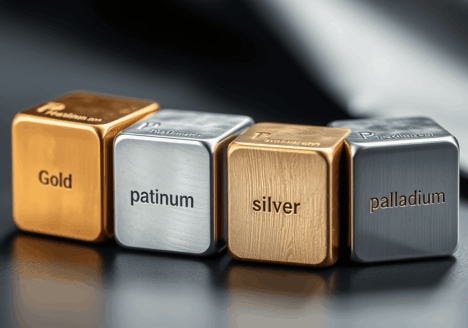
Not all metals are created equal. Jewelry metals fall into two categories: base metals (copper, zinc, tin, nickel, lead, iron) and precious metals (gold, platinum, silver, and palladium). Precious metals earn that designation through their allure, rarity, workability, and durability.
Gold
Gold’s appeal comes from its color, luster, resistance to corrosion, and the simple fact that people have been drawn to it for millennia. Pure gold (24K) is too soft for most jewelry, so it’s alloyed with other metals to increase tensile strength and hardness. Gold is 19 times as dense as water — you can feel the heft in your hand.
The karat system measures gold purity: 24K is 99.99% pure, 18K is 75%, 14K is 58.3%, and 10K is 41.7%. In the US, 14K is the most popular jewelry alloy — a practical balance of durability, color, and cost.
Gold alloy colors depend on what metals are mixed in. Yellow gold (14K and 18K) combines gold with copper, silver, and zinc. Rose gold increases the copper ratio. Green gold increases the silver. White gold uses nickel or palladium with copper and zinc, and is often rhodium-plated for a brighter white finish.
Platinum
Platinum is highly resistant to tarnish, takes a beautiful polish, and is harder to scratch than gold or silver. It rates 900 or 950 fineness (90–95% pure) and is often alloyed with iridium, ruthenium, cobalt, or copper for additional hardness. It can also be rhodium-plated for a whiter finish. Platinum has what metallurgists call “metal memory” — superior holding power that makes it tend to return toward its original shape. That’s why it’s a preferred metal for securing valuable stones.
Silver
Sterling silver is 92.5% silver (925 fineness) with 7.5% copper — the minimum purity to legally carry the “silver” designation in the US. It’s about half as dense as gold, bright white with excellent workability. The trade-off: sulfur in the air reacts with silver to form silver sulfide (tarnish). Vermeil (silver gilt) is a thin coating of gold over silver, at least 2.5 microns thick.
Palladium
A relative newcomer in the jewelry world, palladium is similar to platinum but less dense. It offers a naturally white color without plating, making it an increasingly popular choice.
Ring Settings: How Stones Are Secured
The setting’s primary purpose is to hold a gem securely. But setting style also affects how a stone looks, how much light enters it, and how durable the piece will be in daily wear.
Prong setting — the most common worldwide (called “claws” in the UK and Canada). Metal tips grip the stone, allowing maximum light exposure. The trade-off is that prongs can catch on fabrics and wear down over time.
Channel setting — stones sit in a groove between two metal walls. This is the most durable setting style, with reinforcing bars along the undersides.
Bezel setting — a metal rim completely surrounds the stone’s girdle. Traditionally used for cabochons (domed stones without facets), bezels offer excellent protection.
Pave setting — a variation of bead setting where small stones are set closely together, creating the appearance of a continuous surface of gems. The name comes from the French word for “paved.”
Invisible setting — pioneered by Van Cleef & Arpels, this is the most technically demanding setting style. Each gem is grooved below its girdle and secured between thin metal rails, with no visible metal from the top.
Tension setting — the stone appears to float between two ends of the shank, held in place by the metal’s spring tension. Works best with harder gems.
A semi-mount comes with side stones already set but no center stone — giving you the flexibility to choose your own.
Jewelry Types and What Makes Them Tick
Rings
A ring has two basic parts: the shank (the band) and the head (the part holding the stone). Cathedral shanks rise up to meet a solitaire setting. Engagement rings traditionally feature a diamond solitaire, though the landscape has expanded dramatically. The tradition of both engagement and wedding rings dates to the 1800s. A bridal set (or duo) is a matched engagement and wedding ring pair. A trio adds the groom’s band.
Necklaces and Chains
Standard necklace lengths include 16, 18, 20, 24, 30, and 36 inches. Chokers sit tight against the throat, while collars rest wide above the collarbone. Popular chain styles include curb link (the basic, strong, flexible option), Figaro (alternating long and short links), box chain (angular links resembling tiny boxes), and omega chains (sleek, solid-metal appearance).
Pearl strands remain a cornerstone of fine jewelry. Akoya cultured pearls deliver traditional cream and white, Tahitian pearls offer deep hues, South Sea pearls are golden, and Chinese freshwater pearls have expanded the color palette. An enhancer clips onto a pearl strand to add a removable pendant element.
Bracelets, Earrings, and Pins
Bracelets are among the earliest personal adornments in human history. Earring backs matter more than most people realize — lever backs offer the most security, while clutch backs are the most common. Earring jackets are decorative frames that dress up a simple stud.
Jewelry Through the Ages
Understanding period styles helps when evaluating estate pieces:
Victorian (1837–1901) — matching sets, romantic symbols, mourning jewelry in black, cameos, and even locks of human hair woven into pieces. Defined by the long reign of Queen Victoria.
Art Nouveau (1890–1914) — free-flowing, nature-inspired designs. Rene Lalique was the defining designer of this movement, working with glass, natural motifs, and even mythical imagery like dragons and mermaids.
Edwardian/Garland (1900–1915) — delicate platinum mountings showcasing pearls and diamonds, often with flower, ribbon, and bow motifs. Named for King Edward VII.
Art Deco (1920s–1930s) — geometric patterns, bold contrasting colors, abstract designs, and sleek lines emphasizing the vertical. A dramatic departure from the organic forms of Art Nouveau.
Retro (1940s) — sculptured curves in yellow and rose gold, with floral, bow, and mechanical motifs. When WWII broke out, platinum was reserved for military use and gems were scarce, pushing jewelers toward creative gold work and bold, large-scale designs.
Caring for Your Investment
Fine jewelry requires attention. The safest cleaning method for most jewelry is warm water, mild soap, and a soft toothbrush. Ultrasonic cleaners can shake stones loose, damage fracture-filled stones, and harm porous materials like turquoise, lapis, and opals. Oiled stones should never go in an ultrasonic. Steam can loosen settings and damage treated gems.
Store pieces separately in plush-lined compartments — diamonds can scratch other diamonds, gold, and platinum. Have jewelry professionally inspected every six months. Worn prongs, loose stones, and thinning shanks are all fixable if caught early, and far more expensive to deal with after a stone is lost.
Why Expert Guidance Matters
A jewelry purchase is mainly an emotional decision, but the smartest emotional decisions are made with good information. Whether you’re building a collection, choosing a piece to mark a milestone, or evaluating inherited jewelry for its true worth, having a GIA-trained gemologist walk you through the details changes the experience entirely.
Schedule a complimentary private appointment at KP Gems. Personal. Expert. Entirely on your terms.
Kenny Phillips is a fourth-generation jeweler and GIA Graduate Gemologist. KP Gems has been serving clients in Austin, TX and nationwide for over 40 years — by appointment only.